
Born in 1832 near Manheim in Germany to a Lutheran pastor,
grandson to a history professor, Wilhelm Wundt is considered to be the progenitor
of modern psychology. After studying physiology, he graduated with a medical
degree from the university of Heidelberg before achieving a doctorate in
medicine and coming under the supervision of eminent physiologist Hermann von
Helmholtz as an assistant. (Gregory, 2004).
After studying under Helmholz who was a notable influence, Wundt began to fully
explore his concepts of experimental psychology; in fact his establishment of a
psychology laboratory in Leipzig 1879 is considered to be the birth of modern
psychology by many, although some argue that he had taught the subject since he
became professor of philosophy in 1875 at Leipzig University.
Leipzig university enjoyed an established history of psychology prior to Wundt,
with Ernst Weber and Gustav Fechner having researched sensory psychology and psychophysics,
but it was not until 1883 that Wundt’s own laboratory and thus his new format
of experimental psychology was recognised officially by the university as an
institutional establishment (Pickren & Rutherford, 2010).
Wundt’s work led him to believe that the actuality of intellect was explainable through controlled inductive observation and measurement, he divorced the explanation for psychological consciousness from the concept of a ‘soul’ but was comfortable in utilising his background in philosophy to develop his ‘Wundtian’ Theory of Mind (Kim, 2016).
This rationalist belief that intellect was independent of sensory information led him to develop his theories of Apperception, or ‘relational perception’ (Kim, 2016).
His focus was upon replicable standardised measurements within the controlled environment of his laboratory. This new scientific method drew students from Germany, Britain, Russia, America and several east European nations and many of his students adopted his laboratory model as the standard for psychology (Kim, 2016).
During his lifetime he authored numerous influential books, written from the empirical perspective of a critical realist on such topics as Psychology, Ethics, Philosophy and Scientific Principles. Many remain in print today despite Psychology having moved on as a science (Kim, 2016).
Wundt taught 116 psychology graduates out of his total of 184 PhD graduates and they carried his teachings across the world. Amongst these students, who learned their craft under Wundt’s supervision and influence were James McKeen Cattell who was the first Professor of psychology in the USA at the University of Pennsylvania, G. Stanley Hall who pioneered Child Psychology, Walter Dill Scott an early Industrial Psychologist and Hugo Münsterberg who was an early Applied Psychologist (Pickren & Rutherford, 2010).
Another of his notable students Edward Titchener described Wundt’s work as Structuralism and went on to develop the field significantly (Pickren & Rutherford, 2010). Structuralism is the study of the basic elements of the mind which Wundt accomplished by training his students to introspectively observe their reactions to different stimuli within a controlled environment and then to document their responses. Since that time science has developed better measurement methods, displacing the somewhat subjective method of introspection, but his focus on the study of perceptual processes, ie: thoughts, images and feelings contributed to the study of and further interest in the field of cognitive psychology and alongside his laboratories established Wilhelm Wundt as a founding figure within the history of psychology.
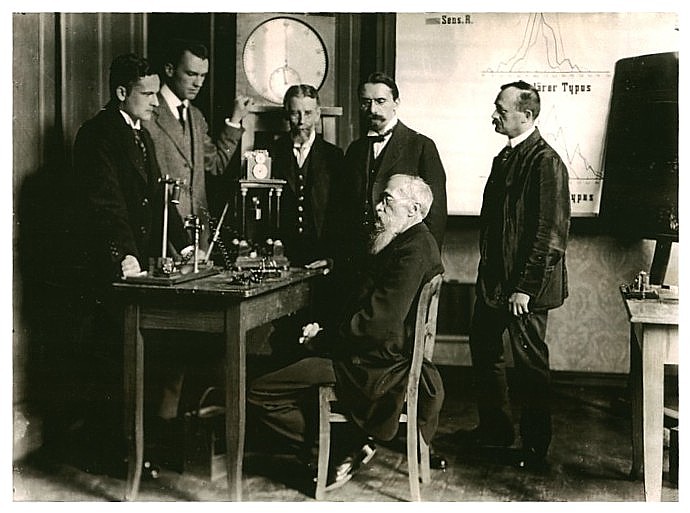
(Unknown, 2019)
References:
Kim,
A. (2016) Stanford Encyclopedia of Philosophy, Wilhelm Maximilian Wundt. Online
at:
https://plato.stanford.edu/entries/wilhelm-wundt/
accessed 17-11-19
Pickren, W., & Rutherford, A. (2010). A history of modern psychology in context. Hoboken, N.J.: Wiley.
Titchener, E.B. (1921). The American Journal of Psychology, Vol. 32. No. 2. Online at: https://www.jstor.org/stable/1413739 accessed 16-11-19
Gregory, R. L. (2004). The Oxford companion to the mind. Oxford UK: Oxford University Press.
Unknown. (2019). Wundt research group, ca. 1880 [Image]. Retrieved from https://commons.wikimedia.org/wiki/File:Leipzig%27te_i%C3%A7g%C3%B6zlem_denemeleri.jpg
Wellcome Collection gallery. (2019). Wilhelm Wundt [Image]. Retrieved from https://upload.wikimedia.org/wikipedia/commons/a/a8/._Photogravure_by_Synnberg_Photo-gravure_Co.%2C_1_Wellcome_L0023076.jpg
 History of Psychology

